ChatGPT is a great translator. A website needs a system.
If you've pasted a page into ChatGPT and shipped what came back, you already know the translations are good. That part is settled, and this page won't argue with it. What it will show you is everything a live multilingual site needs after the translating (staying in sync with your English, holding your brand terms steady, ranking on local search) and why a chat window was never built to carry any of it.
Let's start by agreeing with you.
Paste a page into ChatGPT, ask for French, and what comes back is genuinely good: fluent, natural, and fast. Frontier AI models are strong translators, and anyone who tells you otherwise is selling something. We're selling something too, so let's be precise about what. Bablic will not out-translate ChatGPT sentence by sentence, and this page won't pretend it does. Bablic translates with the same class of AI: best-fit engines chosen per language pair. On the quality of a single paragraph, the honest score is a tie.
Here's the more useful way to see it. ChatGPT is a translation engine, in the same category as Google Translate or DeepL: excellent at turning one passage into another language. What it isn't is the place your website's translations live. It doesn't remember your glossary or the strings you approved last month, it doesn't know the scope of what still needs translating, and it doesn't manage, host, store, or serve a single translated page on your site.
Your website is not a single paragraph. It's a few hundred pages that change weekly, in three or five or ten languages, that have to agree with each other, stay current with your English, and show up on google.de. That is not a translation problem. It's a systems problem, and a chat window is a conversation, not a system.
Day one feels great. Month three is the problem.
The chat-window workflow doesn't fail loudly. It drifts. Here's how it goes.
Twenty minutes, one great page
You paste the homepage in and a genuinely good French version comes back. You paste it into the CMS, check it twice, and ship it. Twenty minutes, no invoice. This part is real.
Forty pages, forty round trips
Now the rest of the site. Every page is a manual round trip, and each chat starts without your glossary or the strings you approved last week, so your product names come back three different ways, and the only quality system is you, proofreading.
The quiet rot
You rewrite the pricing page in English. Nothing tells you the Spanish version still describes the old plans. Pasted translations don't break: they go silently stale, and nobody is checking on them.
Invisible to local search
Even pasted into your CMS at real URLs, the pages ship without hreflang, translated titles and metadata, or a multilingual sitemap unless you hand-build every piece. To google.es, your Spanish site barely exists.
Six jobs a chat window was never hired to do.
None of these are translation. All of them are what keeps a multilingual site alive. Each one, side by side: the chat workflow, and the system.
Getting translations onto the site
Copy out of the chat, paste into the CMS, page by page, again for every language, and again after every edit. The workflow is you.
One line of JavaScript. Every page is detected, translated, and served automatically, new pages included, the moment you publish them.
Keeping terminology consistent
No enforced glossary, no record of what you approved. The same feature gets a new name in each session, and the drift surfaces when a customer asks about it.
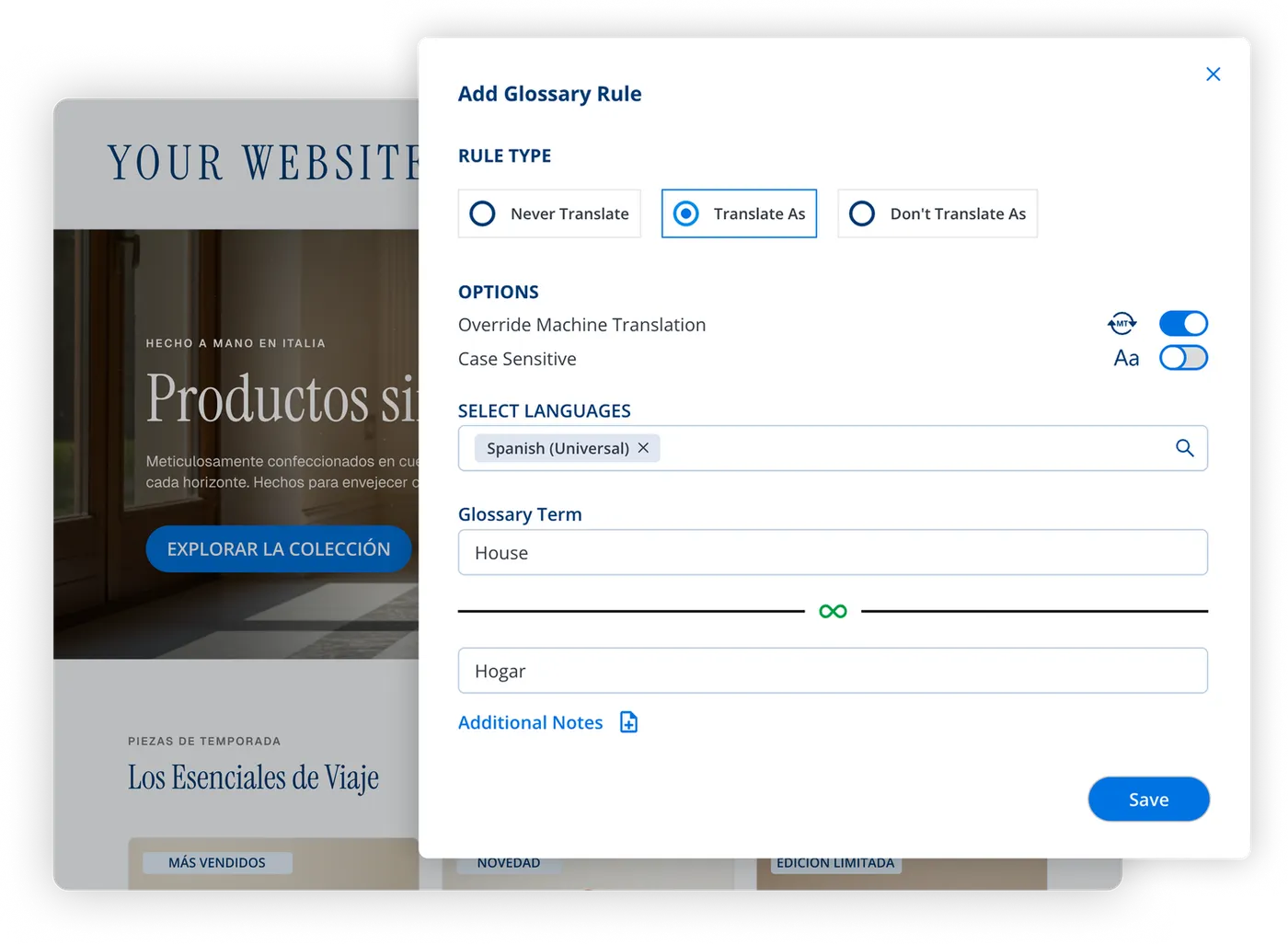
Translation memory stores every approved string and reuses it everywhere, and glossary and brand rules lock product names and tone in every language, on every plan.
Staying in sync with your English
The chat doesn't know your site changed. Every English edit quietly strands its translations until someone remembers to re-paste.
Bablic detects changes the moment you publish and routes the new strings straight into translation. Your Spanish site stops being a snapshot of last quarter.
Being found in local search
Pasted pages carry no hreflang, no translated titles or metadata, and no multilingual sitemap unless you build each one by hand.
Bablic supports deployment on subfolders and subdomains and generates hreflang, translated metadata, and multilingual sitemaps automatically: real, indexable pages, with page speed and Core Web Vitals intact.
Reviewing in context
You review translations in a chat log, stripped of the layout, the button they sit on, and the sentence next to them. What fits in the bubble may not fit on the page.
The visual editor puts every string on the live page, where your team edits it in place, with roles for translator, reviewer, and admin.
Localizing more than words
Translating in a chat window leaves the site's imagery untouched. The German page keeps the English banner and the English size chart until someone rebuilds and re-uploads them by hand.
Asset swap replaces any image with a locale-specific version. Bablic hosts the swapped assets, with no negative impact on your Lighthouse or Core Web Vitals scores.
Bablic runs on frontier AI too.
This was never AI versus no-AI. Bablic translates with best-fit AI engines chosen per language pair (Google, DeepL, TowerLLM, and other AI models), so each language gets the engine that handles it best, instead of one general-purpose model handling all of them the same way.
The difference is what surrounds the model. In Bablic, the AI's output lands in translation memory, gets checked against your glossary, moves through your review workflow, and publishes with the SEO layer attached. Same class of engine: an actual system around it.
Which brings us to the part that surprises people: the tool this page compares against is one of the engines you'll be able to choose inside Bablic. AI Post-edit is coming, and ChatGPT will be among the providers that can run it, reading the context of a whole page instead of one segment at a time, and adjusting translations for your glossary, brand tone, and cultural sensitivity. The model you already trust, with your memory, your rules, and your site around it.
AI Post-edit: reads the context of the whole page, not one segment at a time, and adjusts every translation for your glossary, brand tone, and cultural sensitivity.
Keep ChatGPT. Add a system.
This isn't either-or. A chat tool and a localization platform are good at different jobs. Here's the honest split.
When a chat window is the right tool
- A one-off: an email to a supplier, a document, a paragraph you need the gist of
- Exploring tone and wording before you commit to copy
- Content that will never live on your website
- Quick internal translations where drift and search visibility don't matter
When your website needs a system
- A live site with pages that change: weekly, or mid-promo, hourly
- More than one language that has to stay consistent and current
- Markets you want to rank in on local search, not just be readable in
- Brand terms, legal copy, and prices that cannot be allowed to drift
The teams that get this right use both: the chat window for the one-offs, the system for the site. And with AI Post-edit coming, the model you already trust will be one of the options working inside it.
Fair questions, answered straight.
Including the one about whether you even need us.
On a single sentence, no, and Bablic won't claim otherwise. Both draw on the same class of AI, and Bablic selects best-fit engines like Google, DeepL, and TowerLLM per language pair. The difference is consistency at scale: translation memory, glossary rules, and a review workflow keep quality uniform across hundreds of pages and months of edits, which a series of separate chat sessions has no mechanism to guarantee.
For a page or two, yes, and the results will be good. The cost appears as the site grows: every page is a manual round trip, every English edit strands its translations until someone re-pastes, and every session starts without your glossary or your approved strings. Bablic replaces that loop with one snippet and automatic detection.
Not on their own. Ranking in a market takes translated pages at real URLs with hreflang tags, translated titles and metadata, and a multilingual sitemap, none of which a chat window produces. Bablic supports deployment on subfolder and subdomain structures and generates all of it automatically, with page speed and Core Web Vitals intact.
Yes. Bablic translates with best-fit AI engines chosen per language pair, including Google, DeepL, TowerLLM, and other AI models, across 130+ languages. An AI Post-edit capability is coming soon: it reads the context of the whole page and adjusts translations for your glossary, brand tone, and cultural sensitivity.
Soon, yes. AI Post-edit is coming to Bablic, and ChatGPT will be one of the providers you can choose to run it. The difference from pasting is everything around the model: what it produces is stored in translation memory, checked against your glossary, reviewable by your team in context, and served on your site with the SEO layer attached.
Bablic detects the change the moment you publish and routes the new strings into translation, so your other languages stop going quietly stale. In a paste-based workflow, that job belongs to whoever remembers.
Yes. Every string is editable in context on the live page in the visual editor, with translation-memory matches and glossary suggestions alongside, and roles for translator, reviewer, and admin.
Bablic starts at $19 a month on the Go plan at 1,000 visits a month, with Core and Pro scaling by traffic, annual billing 16% less than monthly, and custom plans past one million visits. A chat workflow's real price isn't the subscription: it's the team-hours spent running the paste loop by hand, every week, in every language.
Stop pasting. Start publishing.
One snippet, and your first translated page is live in minutes: in sync, on brand, and indexable. Keep ChatGPT for everything else it's great at.