Website translation, without word limits.
Tired of watching your word count? Weglot charges by the word. Bablic charges by traffic. Our model lets you grow your content freely while the other makes you think twice before publishing.

What's the difference between Bablic and Weglot?
Weglot and Bablic both work across any CMS and share many of the features growing businesses need, but the differences are important.
Pricing based on traffic
You pay for visits, not words, so your plan scales with your business.
Backed by TransPerfect
The same expertise behind the world's largest translation company is behind every product decision at Bablic.
How does Bablic compare to Weglot?
Which visual editor is better?
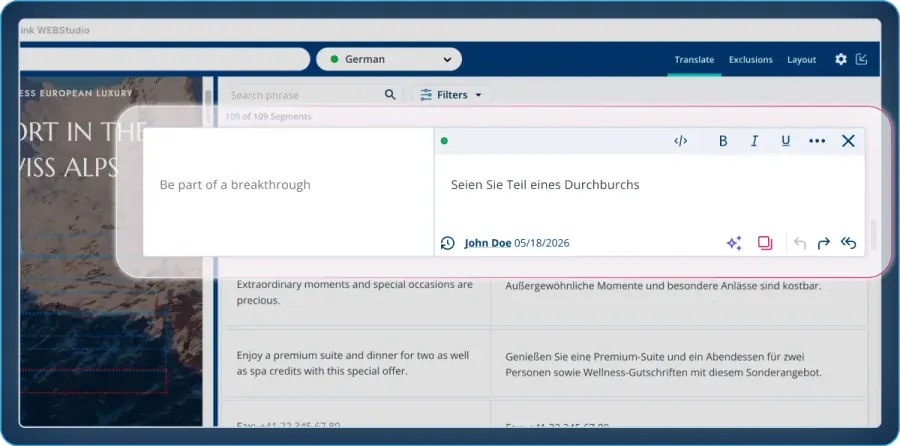
Weglot's editor lives in a browser tab. Bablic Studio is a native desktop app, synced with your browser dashboard in real time: translators work in the app, reviewers work in the browser, nothing falls out of step.
The pricing problem with Weglot.

Every new page has a hidden cost.
Weglot's word-count model means every piece of new content comes with a hidden cost. Publish a new product page, update your blog, or expand into a new market and your translation quota might run out. Hit your limit mid-cycle and you're either upgrading to the next tier or watching untranslated content sit on your site.
Publish as much as you want.
Bablic works differently. Pricing is based on the traffic your site receives, not the words on it. Your team can publish freely, update content as often as needed, and create new pages without ever worrying about running out of words.
Why content-heavy sites outgrow Weglot.
Weglot's pricing tiers can become expensive quickly as your content grows. Every page you publish adds to your word count, and high-traffic, content-rich sites can find themselves regularly bumping against tier limits.
Bablic's traffic-based model scales naturally with your business. Within your plan, the price reflects how many visitors your site receives, not how ambitious your content team is.
What switching looks like.
Moving from Weglot to Bablic doesn't mean downtime for your translated pages. Your Bablic account runs in parallel with your existing setup. You review everything first and only switch when you're fully satisfied. Your translations stay live throughout.
Backed by  .
.
Most localization tools are built by software companies that learned translation along the way. Bablic, on the other hand, is built by TransPerfect: the world's largest translation company, with 30+ years serving global enterprises across every industry and language pair imaginable.
Frequently asked questions.
Yes. Weglot's pricing is based on the number of words translated across your site. Every new page, blog post, or product description you publish counts against your quota. If you hit your limit mid-cycle, you either upgrade to the next tier or leave content untranslated until your plan resets.
Each language you add in Weglot gets its own word count allocation, which resets your quota. For content-heavy sites expanding into multiple markets, this means costs can scale quickly and unpredictably as your content grows.
Bablic charges based on traffic: the number of visitors to your translated pages, not the number of words on your site. Your team can publish new content and update existing pages without it affecting your plan. The price reflects how your business grows, not how much your content team writes.
Yes, but they work differently. Weglot's editor lives in a browser tab and opens a panel when you click on text, so you edit one segment at a time in a box separate from the page. Bablic Studio is a native desktop app, synced with your browser dashboard, that renders your live site beside a full segment list. Every change is visible in context as you make it, so layout issues surface before anything goes live.
Yes. Bablic runs in parallel with your existing Weglot setup. You review and refine everything before making it live, and your translated pages stay active throughout the process. You only switch when you're fully satisfied.
Lots. The main differences are the pricing, the visual editing experience, and the team behind the product. Bablic charges by traffic, renders translations as they would appear live on your site, and is backed by TransPerfect, the world's largest translation company.
Most teams complete the move in a single afternoon. Bablic's onboarding team helps you import your existing translation memory and glossaries, so nothing gets re-translated. Our team handles the DNS and hreflang cutover with you so the old URLs continue to redirect cleanly.
Yes. Bablic supports TMX, TXML, TXLF, XLIFF 1.2, and XLIFF 2.0 imports. Anything your team already edited stays edited. The in-context editor inherits your overrides on the first crawl.
In practice, no. Bablic uses the same SEO-friendly subdomain / subfolder structures most competitors do, and generates hreflang tags automatically. Because we redirect every existing translated URL one-for-one, search engines see continuity rather than a new build.
Ready to translate without limits?
Start your free Bablic trial and see the difference a traffic-based model makes.